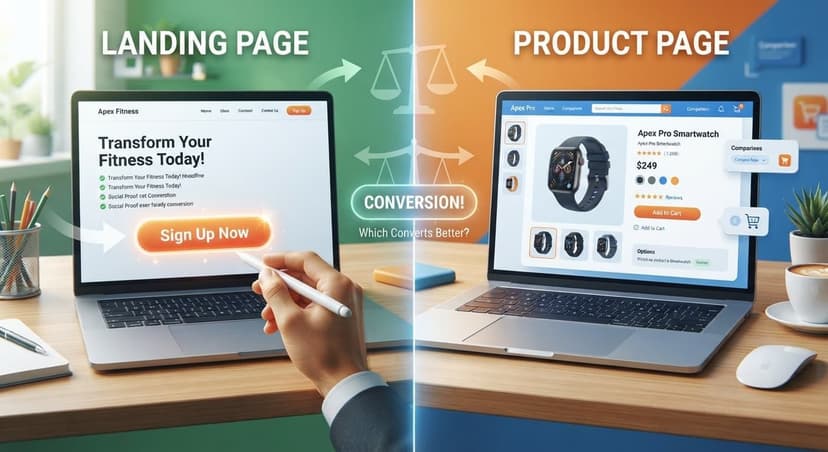
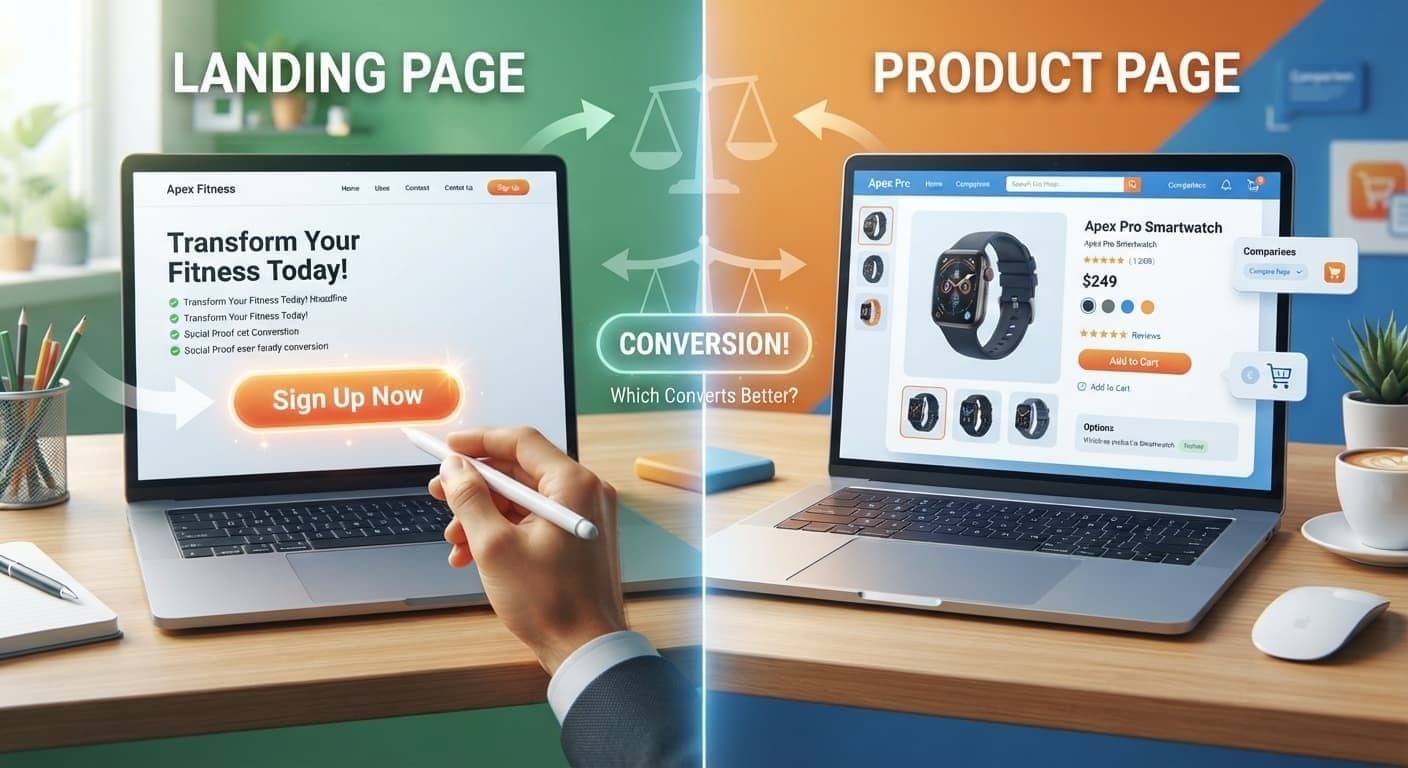
You have a good product. You have an ad ready to go. People are clicking.
Then what?
Where those people land on your website matters more than it may seem. A customer who clicks an ad for one product does not necessarily want to browse your entire store. At the same time, someone discovering your brand for the first time may need a little more information before they feel ready to buy.
That is why the question “Landing page vs product page which converts better?” is not as straightforward as it sounds. Sometimes a landing page is the right choice. Sometimes the product page is exactly where the customer should go. The difference usually comes down to what the customer expects to find after clicking.
What Is a Landing Page?
A landing page is a page built around one particular purpose. It could be created for a discount, a new collection, a product launch, or a specific advertising campaign. Instead of giving visitors the full range of your website's options, it keeps their attention on one message.
Think about a clothing store advertising a summer sale. The ad might say, “Summer styles up to 40% off.” Clicking that ad and arriving on a page that immediately shows the sale, explains the offer, and displays the relevant products feels natural. Sending the same person to the store's homepage, where they have to look for the sale themselves, adds an unnecessary step. That is the basic idea behind a landing page: the page continues the conversation that started with the ad or search result.
What Is an Ecommerce Product Page?
An ecommerce product page is where customers go to learn about and purchase a particular product. This is usually where they find the product photos, price, description, sizes or variations, specifications, reviews, delivery information, and purchase button.
Imagine someone searching Google for a particular skincare product. They are probably not looking for a general introduction to the brand. They want to see the product. They may check the ingredients, price, reviews, available sizes, and delivery options before deciding whether to add it to their cart.
A good product page makes that decision easier by putting the relevant information in front of the customer. It also needs to be easy to navigate. If a customer has to hunt for the price, figure out how to select a size, or search for delivery information, the problem is no longer just the product. The page itself is getting in the way.
Landing Page vs Product Page: What Is the Difference?
The easiest way to understand the difference is to look at what each page is trying to accomplish. A landing page is usually built for a particular campaign or audience. A product page is built around a particular product.
For example, an online store could run a Facebook ad promoting a Mother's Day gift collection. A landing page could introduce the collection, explain the promotion, and show several products.
Now imagine another customer searches for “silver necklace with pearl.” That person may have much stronger product intent. Sending them directly to the relevant product page could save them time.
This is why Product page vs landing page for ecommerce is not really a question of which page is “better.” The more useful question is: which page makes sense for this visitor?
Landing Page vs Product Page: Which One Converts Better?
So, landing page vs product page: which one converts better?
There is no fixed winner. A landing page may work better when the customer needs to understand an offer or when you want to keep them focused on one campaign.
A product page may work better when the customer has already decided what they are looking for. There are other things that can affect the result too. Price, trust, reviews, page speed, the quality of the offer, the checkout process, and even the wording of the ad can change how visitors behave. For that reason, it is usually more useful to look at your own store data than to rely on a general rule.
If visitors from one campaign are adding products to their carts but not completing checkout, for example, the problem may have nothing to do with whether you used a landing page or product page. The offer, product information, shipping costs, or checkout experience could be the real issue.
The page is one part of the buying journey, not the whole journey.
When Should You Use a Landing Page?
A landing page makes sense when you have something specific to say and want the visitor to focus on it. You are promoting a special offer. Limited-time offers are a common reason to create a dedicated landing page.
Suppose an online store is running a “Buy 2, Get 1 Free” promotion. A customer clicking the ad should not have to search the website to understand which products are included. A landing page can explain the offer, show the eligible products, answer basic questions, and take the customer toward the purchase.
The same idea can work for seasonal sales, bundles, new collections, and product launches. You are targeting a specific audience. Sometimes the same product can be marketed differently to different groups.
A beauty brand, for example, might speak differently to someone looking for a simple skincare routine than to someone shopping for a complete set of products. A dedicated landing page gives you room to adjust the message without changing the entire website.
You need to explain the offer. Not every purchase decision happens in a few seconds. If a product is new, relatively expensive, unfamiliar, or part of a more complicated offer, customers may have questions before buying.
A landing page can give you space to answer those questions. You can explain the benefits, show how the product works, include customer feedback, and then give visitors a clear next step.
When Should You Send Traffic to a Product Page?
Sometimes there is simply no reason to add another page between the customer and the product. If someone searches for a specific product and clicks an ad or search result that promises that exact item, taking them directly to the product page can be the most straightforward experience.
They can immediately see the price, images, description, reviews, available options, and purchasing information. This is particularly useful when the product is easy to understand and the customer already has strong buying intent.
For example, someone searching for a specific phone case probably does not need a long campaign page explaining why phone cases exist. They need to know whether that case fits their phone, what it costs, and how quickly it can be delivered.
In that situation, fewer steps can be helpful. How Traffic Source Affects Landing Page vs Product Page Performance. The source of your traffic tells you something about the person arriving on the page. Someone who discovers your brand through an Instagram ad may have never heard of you before. They might need to know who you are, what you sell, and why the product is worth considering. Someone searching for a very specific product on Google may already be much further along in the buying process.
So if you are asking, Should I send ads to a landing page or product page?, start with the traffic rather than the page. Look at what brought the visitor there.
What did they search for? What did the ad promise? Is the product already familiar to them? Are they looking for information, or are they ready to compare prices and buy? The destination should answer those questions as quickly as possible.
Landing Pages vs Product Pages for Paid Ads
Paid advertising makes this decision particularly important because you are paying for every click. If your ad says, “Shop our new black leather handbag,” sending someone to a page featuring that handbag makes sense. They clicked because they wanted to see it.
But imagine an ad saying, “Explore our new summer collection.” Sending the visitor to one random product could feel restrictive. A landing page showing the collection may make more sense. There is also the issue of message matching. If your ad promises 30% off but the customer lands on a page where they cannot immediately find the promotion, they have to figure out what happened. That small moment of confusion can be enough for someone to leave.
Whether you use a landing page or a product page, the important thing is that the experience after the click feels connected to the message that earned the click in the first place.
Landing Pages vs Product Pages for Organic Search
Organic search brings another layer into the discussion because people use Google for very different reasons. A person searching for a specific product may want to see a product page. Someone searching for a broader topic may not be ready to buy yet.
For example, “best running shoes for beginners” and “Nike running shoes size 42” show very different types of intent.
The first searcher may still be researching. The second is much closer to choosing a product. This is where a clear structure becomes important for e commerce websites. Product pages, category pages, and useful content should each have a clear purpose instead of competing with one another. SEO also works better when the page actually answers the searcher's question. Adding a keyword repeatedly does not make a page more useful. The content should make sense first.
Should Your Ecommerce Store Use Both? There is no reason your store has to choose one and forget the other.
In fact, most ecommerce businesses can use both depending on what they are trying to achieve. Your product pages can handle everyday product searches and purchases. Landing pages can support campaigns, special offers, new collections, and targeted advertising. You might have product pages for individual items, category pages for groups of products, landing pages for paid campaigns, and informational content for people who are still researching. What matters is how all these pages work together.
There is another part of the equation, too: the platform your store runs on.
If you are constantly struggling to add products, manage categories, handle payments, or keep the buying process organized, even well-written landing pages will not solve the bigger problem.
That is why choosing the right
For businesses looking for an ecommerce website builder, the platform should make the day-to-day side of running a store manageable, not just help you put a homepage online.
The same applies when comparing an ecommerce site builder. Look at what you will actually need once the store is running: product management, payments, customer experience, and tools that support the way you market your business.
This is one reason businesses may look at ZMatjar when setting up their online store.
The ZMatjar platform is designed to help businesses create and manage ecommerce stores, with features such as payment gateways, multilingual support, SSL, and WhatsApp ordering.
For a business creating an ecommerce website, having these functions available as part of the store setup can make the process easier to manage.
Instead of thinking about your landing page, product page, payment process, and customer communication as completely separate pieces, you can look at the entire experience as one journey.
A customer sees an ad. They click. They arrive somewhere that makes sense. They find the information they need. Then they have a clear way to buy. That is what a good ecommerce setup should help you achieve.
Conclusion
The landing page vs product page question does not have one answer that works for every ecommerce business.
A landing page can be useful when you need to tell a story around an offer, campaign, or audience. A product page can be the better destination when the customer already knows what they want and is ready to look at the product itself. And you do not have to choose one permanently. Your store can use both, depending on where your customers are coming from and what you want them to do.
The bigger picture is your entire ecommerce setup. Your ads, landing pages, product pages, payments, and checkout should feel like parts of the same experience. With the right ecommerce website builder and a store structure that fits your business, you can spend less time making customers figure out how to buy and more time giving them a reason to do it. That is ultimately what the page after the click should accomplish.
Also read: Best Ecommerce Platform for Small Business UAE
FAQs
Should ecommerce ads link to a landing page or product page?
It depends on what the advertisement is promoting and how much information the customer needs.
For a specific product ad, a product page can be a direct route to the purchase. For a collection, promotion, or campaign that needs more explanation, a landing page may make more sense.
The important thing is to make sure the page visitors see matches the promise made in the ad.
Should Google Ads traffic go to a landing page or product page?
Look at the search intent.
If someone searches for a specific product, taking them directly to that product page can make the experience quicker.
For broader searches, a landing page can give the visitor more information before asking them to make a decision.
The best destination is the one that most closely matches what the person was looking for.
When should I use a landing page instead of a product page?
A landing page is useful when you are running a specific campaign, promotion, collection, or offer and want to control the message visitors see. It is also helpful when customers need more information before they are comfortable making a purchase.
When should I send customers directly to a product page?
Send customers directly to a product page when they are already interested in a particular product and are likely looking for its details.
If they have already searched for the product by name, adding another step between the search and the product may not add much value.
Also read: eCommerce Growth in the UAE Trends Opportunities